By Clive Knights
Part one reframed collage as an ancient human impulse — a way of gathering fragments, remembering, and nudging meaning into being. In part two, Clive Knights moves from history to practice. He treats collage as a making-through: a conversation between hands, paper and a lived world, an improvisation that unfolds rather than a plan to be executed. Here collage is shown as material and synesthetic — theatrical, poetic, musical — a process that relies on surprise, gesture and the tacit knowledge of the body. Read as much with the fingertips as with the eyes, these pages ask us to stay with the not-yet-whole, to listen to how fragments argue, reconcile and finally sing.
This is Part 2 of Fragmentary Gestures Towards the Invisible.
PART 2: WHAT COLLAGE CAN BE
It is important to note that the act of collage making is a collaboration between an artist’s embodied imagination, their active body, the fragments of paper that they have gathered around them, and the enfolding continuity of a lifeworld. A collage aims to be a representation of the context of life borne of participatory involvement and as such, must emerge without pre-planning in the spontaneity of imitative play. They are not illustrations of pre-determined ideas or concepts, where ‘illustration’ literally means to shine light onto something already formed elsewhere by some other process. Nor is collage making a projection of idealized form onto unsuspecting matter, but rather, as the anthropologist Tim Ingold argues when speaking about the practice of human making in general, it is “one of gathering, more analogous, perhaps, to sewing or weaving than to shooting arrows at a target. As they make things, practitioners bind their own pathways or lines of becoming into the texture of the world” (Ingold 178)
When thinking about collage making I am also drawn to the analogy of how an animate conversation plays out. No conversation between two or more parties starts by knowing the outcome, by having a preconceived sense of final, singular form, for it is emergent meaning that holds the attention and curiosity of all parties, together. To enter a conversation is to tacitly believe in the possibility of accomplishing common understanding through an openness that refuses to preempt how this might present itself. Each contributor’s input is thus an improvised fragment set against other fragments, together on a collaborative journey towards potential meaning. If my interlocutors are other humans, or fragments of cut and torn paper, the task is much the same. Engage openly, converse responsively, attend to body language and gesture, discover identity in difference, without eradicating difference in the process.
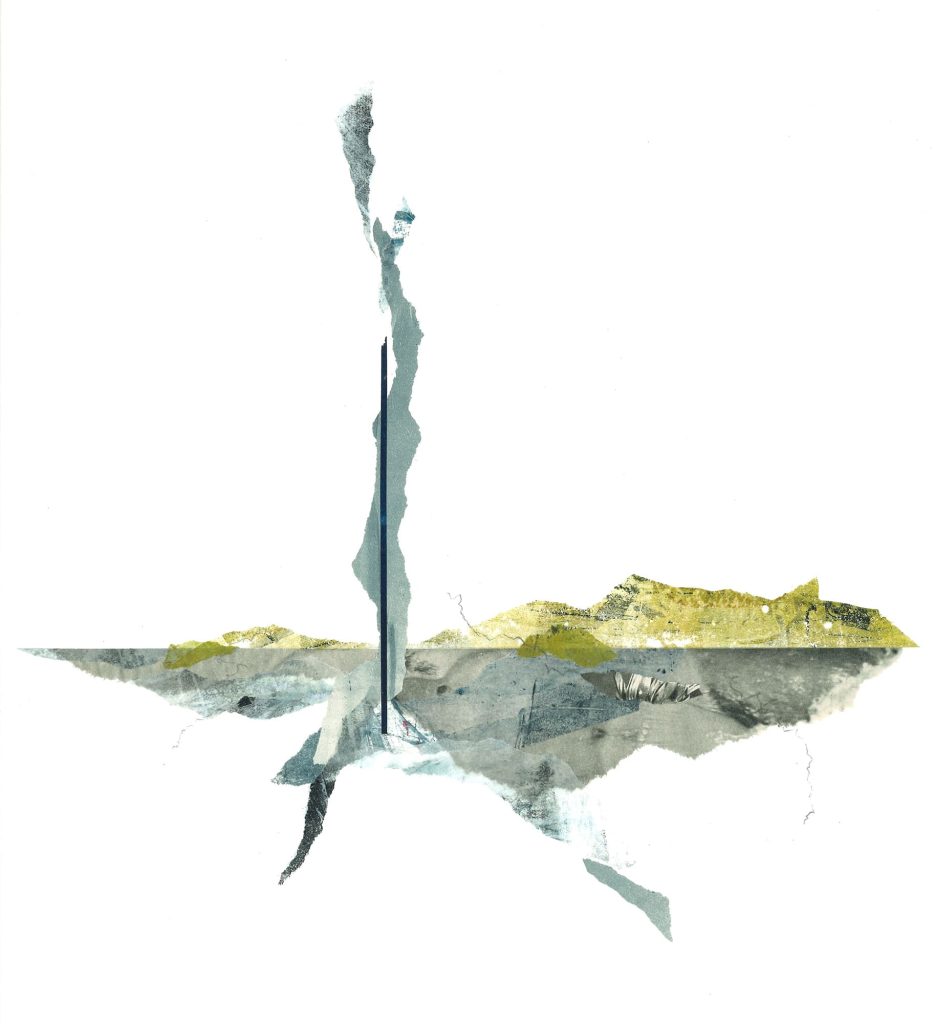
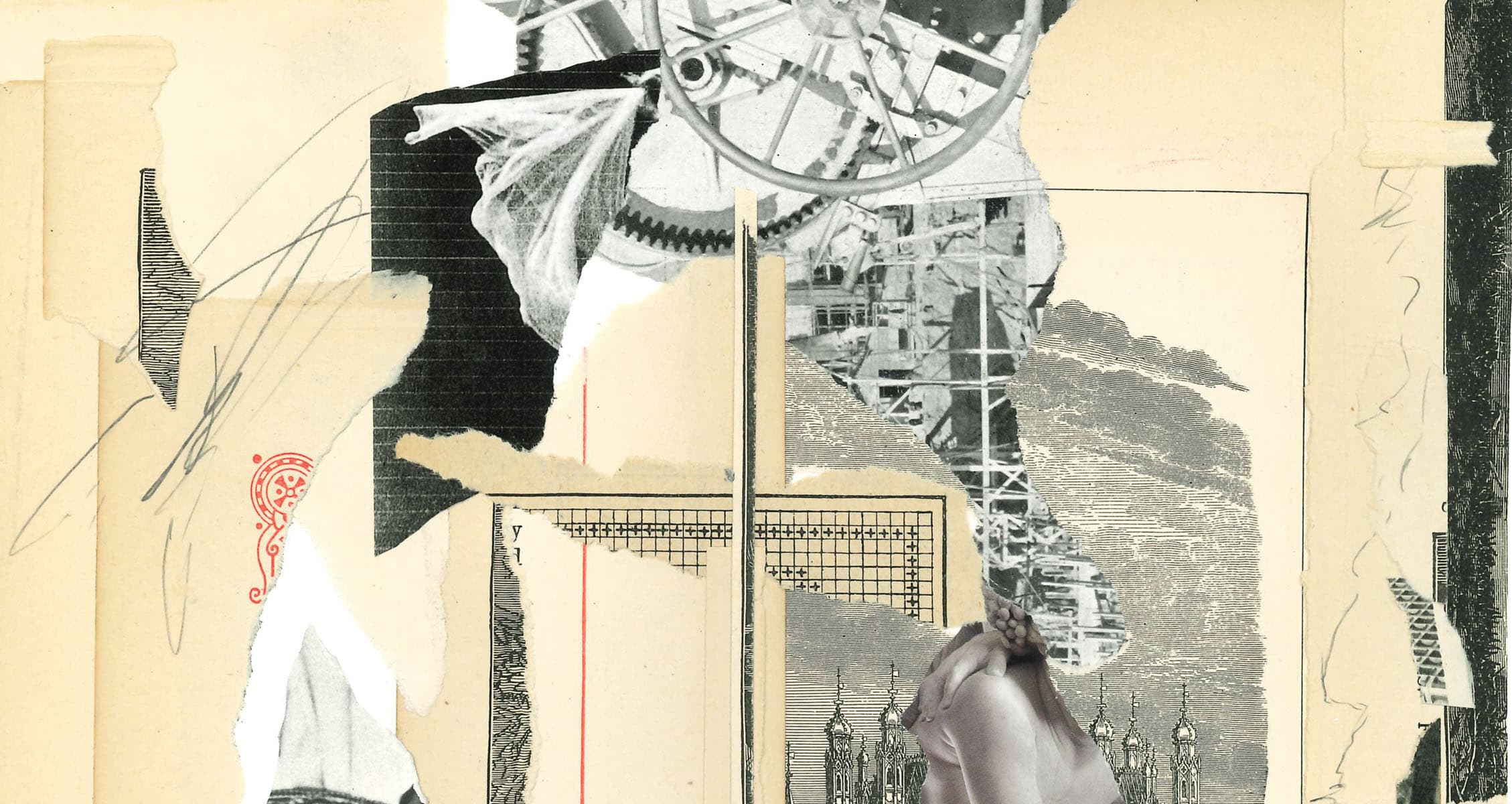
Collage, of course, is not a spoken artifact, and neither is it a purely visual phenomenon of distanced contemplation. It is gestural and synesthetic, both in its making and its receipt. It is not a titillation of sight, though nevertheless having a visual dimension. It is a material phenomenon, a work of corporeal engagement with matter, it is a precipitation – layered, sticky, wrinkled, tonal, wrapped, creased, colored, rubbed, bulky, textured, torn, erased, excavated, folded, layered, splayed, encrusted, smoothed, peeled, fibrous, obfuscating yet revelatory. Every collage is an outward gesture rather than a solipsistic introversion, even if mining the psyche is an artist’s particular motivation. The collage unearths and lays bare in paradoxical acts of covering up, but through this tensive process figurations of possible worlds coalescence from the collaboration of fragments. Put another way, all poetic making activates the dexterous capacities of the mortal human body in refiguring the perennial stuff of the world in the hope of touching at least a modicum of its eternity. In his book Gestures, Vilém Flusser characterizes the existential dilemma of the gesture of making as follows, “The two hands come infinitely close to one another, but their perfect agreement is never achieved. This is a border situation. At no time can it be said that the work is complete. There is always a distance, however infinitely small it may be, that divides the two hands in the [made] object. This integration of the hands in the object, the ‘wholeness’, that is, is always elusive. In the sense of an ideal of being ‘wholly finished,’ the work is never perfect. The gesture of making is an interminable gesture… The gesture of making ends with the opening of the hands to others. Seen from its conclusion, the gesture of making is therefore a gesture of love with respect to another. The wholeness the hands seek in the object, without ever being able to find it, is a gesture of disappointed love. It is a specifically human gesture. It seeks to overcome the human condition and ends, beyond resignation, in love” (Flusser 46-47).
Without any presumption of comprehensiveness, and in the spirit of wonder that I find myself captivated by in encountering collages, I want to further briefly characterize collage in three ways that I sense partly sustains its fascination for those who make them, and those who enjoy them, often the same people.
The first characterization is collage as poem, since both literary poetry and collage emerge as the creative manipulation of a collective currency of existing semantic phenomema – words or visual images already known by a community, as extant artifacts of meaning. Both words and images can be read literally in promoting a utilitarian signification in the clear, direct and unambiguous transmission of sense or pre-conceptualized messages. Artful deployment by the poet or collage maker, however, demands a figurative response to this common currency, imaginatively conjoining elements to release innovations of meaning, placing familiar components in new and unfamiliar arrangements that spark the incantations of metaphor. As the poet challenges the units of vocabulary, along with the structures of prose, of grammar, of phrasing, and of format, so the collage maker challenges the units and structures of commercial publishing, cutting icons free from the strictures of mass-media propriety manifest variously as layout templates, marketing identities, typographic conventions, standardized paper and colour, manufacturing processes and so on. In marshaling these image-beasts, once released from their cages, the collage maker cohabits with them in a newly opened field where speculative horizons of meaning can be drawn. There, graphic potential is reanimated, visual qualities are reinvigorated, metamorphic capacity is revitalized, and a freedom to initiate new conversations is cultivated. I have written elsewhere about the contribution of what I call ‘strangers at the studio table,’ my personification of this indefinite otherness, this feral, un-tempered, menagerie of electrified creatures that populate the collage maker’s studio, aroused and chattering amongst themselves while jostling to offer their contribution to the company of others in burgeoning collage works. A good collage emerges in a manner similar to how Don Paterson speaks of the good poem which will have “the certainty of a thing recalled as true… A good poem often seems to arrive with an air of perfect inevitability – so much so we so often suspect our best lines of having already been written by someone else” (Paterson 14). The collage artist’s aim is to be guided by fragments, as the artist, in turn, guides them, in the manner of reciprocal persuasion.
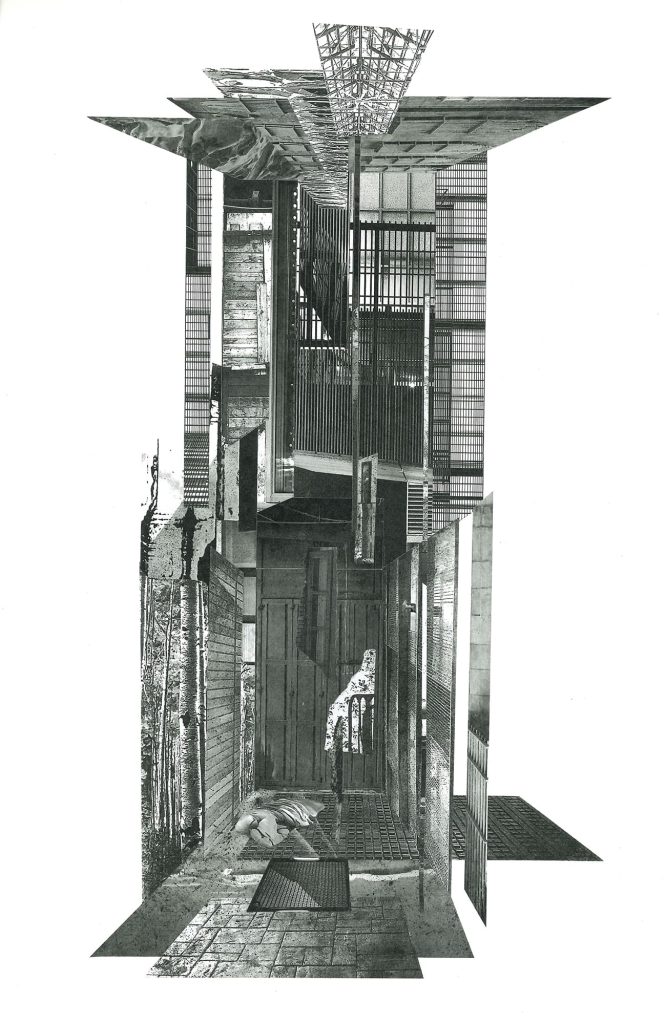
The second characterization is collage as theatre, as the drama of human figures in action embroiled in fictive scenarios, in newly imagined plots. A cursory swipe through the current Instagram hashtags for collage artwork reveals that approximately two thirds of collages being posted incorporate images of the human body either inhabiting imaginary worlds or as spliced and dismembered humanoid organisms. It is striking the degree to which the disfigured human body populates contemporary collage, as if the sense of unity our body tends to present to our perception is the illusion of an identity we crave to surpass, to exceed, a skin to be shed, a persona to be reformed in some version of an ideal, whether exalted or degraded, it seems to go both ways, to become angelic or to become bestial. Disembodied eyes, faces, hands, and limbs predominate and take on a mythic status in the narratives enfolding these symbolic exaggerations of human attributes – the visceral power of the expressive visage, the choreography of glances, the carnal implications of reaching and touching. In collaging with fragments of the human figure it is as if we are trying to reconstruct the memory of a person whose image we have long forgotten, a super-human perhaps. When the stark, ordinariness of the photograph is no longer enough, when its ability to capture the aura of human identity has evaporated, the cutting and pasting of the collagist fleshes out amplified bodies, re-writes their stories, installs these fictive characters theatrically into reframed settings. It is to imagine being someone else, some ‘thing’ else even, enmeshed in another place, another community where mundane responsibilities give way to alternative possibilities, to a vision of altered values. This brings us back to the importance of the mimetic act of creation, making representations of human action appear, which in collage, I suggest, resonates with what Gadamer says about theatre in producing, “the alien shock that shakes our comfortable bourgeois self-confidence and puts at risk the reality in which we feel secure. Here we no longer come to self-knowledge within the sovereign realm of our inwardness. We recognize ourselves as the plaything of the mighty, supra-personal forces that condition our being” (Gadamer 64). It is those strangers again, insinuating themselves into the stories of our lives, actors with extraordinary temperaments that offer up cathartic relief upon the stage of the collage. In this way collage is theatre within reach, up close, no further than the distance to one’s fingertips. When Peter Brook says all that is needed for bare theatre is an empty space across which somebody walks while somebody else is watching, so too, as the human figure, or its icons, are glued to a blank sheet of paper and somebody looks at it, collage is born. Though both emptiness and blankness, of course, are never absolutely vacant, since each is still a state of affairs, a topography, bounded by horizons. It is collage as theatre, as the speculative inhabitation of imagined ‘sets’ on which the narratives of human life play out, that its efficacy in the creative processes of architecture truly shines, and where collage finds a place in my own architectural teaching and practice.
The third characterization is collage as song, as a sonorous outpouring of extemporal musicality issuing straight from the body, like that of birds, like the chant, like humming, like scat singing, or the extraordinary word-free vocal virtuosity of Meredith Monk. Collage work in the manner of song avoids the immediately recognizable image (face, animal, tree, landscape and so on) to engage concrete qualities through the choreography of textures, tones, colours, layers, tactile gestures offered up by a chorus of fragments in which the artist is but one contributing voice. Poets often speak of musicality as one means of pulling familiar words down from the cerebral plane of their abstract literalness in order to engender a more visceral encounter in the reader where sound and touch intersect in the word to incite new meanings. The collage artist can cut or tear away the immediately identifiable attributes of an image as this or that thing, dismantling obvious figures back into their carnal substance, to a state where a new song can ring forth unfettered by familiar reference. Richard Kearney reminds us of a deep proximity where “sound and touch are ontogenetically primary, their synergy providing a base camp of bodily sensibility and security throughout our lives. The synesthetic mix of tactile-aural experience is associated, accordingly, with our deepest hurts and healings, as mothers and lovers well know. Since the skin is another ear – our first ear – it attunes us to musical elements like volume, timbre, and tempo when caressing or being caressed by a loved one” (Kearney 28-29). All poetry should be read aloud, should be sung; all collage should be held in the hand, should be caressed, at the very least massaged with the eyes. As a practice of making, collage is exemplary in the engagement of hands as they touch every contributing fragment, often multiple times, including the ones that do not make it into an ongoing work, that do not feel right for the occasion, whose voice is not quite attuned to the current piece, but may resonate perfectly with a later one.
Finally, as the collage artist’s hands flail amidst the babble of fragments gathered across their desk, as their eyes scan the faces in the crowd of hopefuls, as their heartbeat sets a tempo, as their lungs heave to the rhythm of breath, as their torso is poised in the posture of making, as daylight saturates the room with its transient energy and this whole vital ensemble settles down for another imaginative conversation; as each new collage coalesces in birth, the offspring of the ones before it and the progenitor of the ones that come after, as the artist is swallowed up by the unrelenting joy of making, it is well to be reminded of the poet’s wise words from the Four Quartets:
“We shall not cease from exploration
And the end of all our exploring
Will be to arrive where we started
And know the place for the first time” (Eliot 59)
Learn more about Clive Knights on his website or Instagram
Bibliography
– Aragon, Louis, “The Challenge to Painting” TheSurrealistsLookatArt,edited by Pontus Hulten, Lapis Press, 1990, pp.47-74
– Brook, Peter. TheEmptySpace.Simon & Schuster, 1968
– Eliot, T S. FourQuartets.HBJ Books, 1943
– Elliott, Patrick. “Collage Over the Centuries” Cut and Paste: 400 Years of Collage,National Galleries of Scotland, 2019, pp.9-23
– Flusser, Vilém. Gestures.U Minnesota Press, 2014
– Gadamer, Hans Georg. TheRelevanceoftheBeautifulandOtherEssays, Cambridge UP, 1986
– Ingold, Tim. BeingAlive.Routledge, 2011
– Johnson, Mark. TheMeaningoftheBody.U Chicago Press, 2007
– Kearney, Richard. Touch.Columbia UP, 2021
– Merleau-Ponty, Maurice. TheVisibleandtheInvisible.Northwestern UP, 1968
– Nochlin, Linda. TheBodyinPieces.Thames & Hudson, 1994
– Paterson, Don. ThePoem. Faber & Faber, 2018
– Paz, Octavio. TheBowandtheLyre. U Texas Press, 1987
– Ricoeur, Paul. InterpretationTheory. Texas Christian UP, 1976
– Schweiker, William. MimeticReflections.Fordham UP, 1990
– Vesely, Dalibor. ArchitectureintheAgeofDividedRepresentation. MIT, 2004
– Wheelwright, Philip. MetaphorandReality.Indiana UP, 1962