Paul Henderson is an artist and arts worker with a tertiary interest in graphic design and self-publishing. Primarily working in collage, he has participated in residencies and exhibited his award-winning work across Canada and around the world. He is one of the seven artists featured in The Weird Show Gallery’s inaugural exhibition, Phantom Tigers & Parallel Papers. In this interview, he will discuss his works on display.
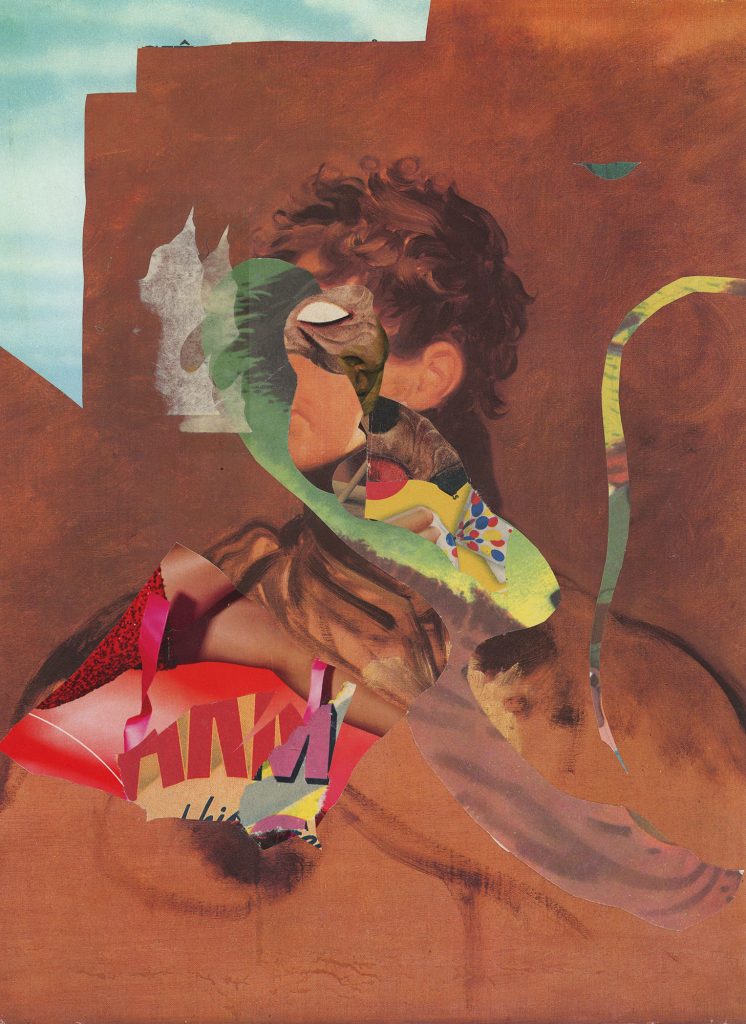
Analog paper collage
Buy this original artwork on TWS Gallery
TWS – Hi Paul, how has 2025 been for you? What have been your highlights so far, and how does Phantom Tigers & Parallel Papers fit into your year?
PH – It’s been a quiet year for me in many ways. I wasn’t able to carve out as much time in the studio as I’d like and there weren’t a lot of exhibition opportunities either. Phantom Tigers & Parallel Papers and The Weird Show Gallery was a nice surprise this fall. I’m excited by your initiative and I hope the project continues to be a success.
TWS – You work with an incredibly wide range of source material—art history, medical textbooks, religious ephemera, magazines, junk mail. How do you navigate all these different visual languages? What draws you to combine things that seem like they shouldn’t belong together?
PH – My desk is a chaotic mess of cut material that is constantly being shuffled and added to. A lot of what happens is random. I also have a substantial library of material and I’m always adding more. Sometimes I’m drawn to formal elements (pattern, colour, shape etc.) other times it’s the image or potential meaning of a thing. I use a lot of illustrated material opposed to photos, so there is still a kind of unity that happens through the hand drawn or painted image, despite obviously pasted juxtapositions. It’s a pictorial language similar to and influenced by painting traditions.
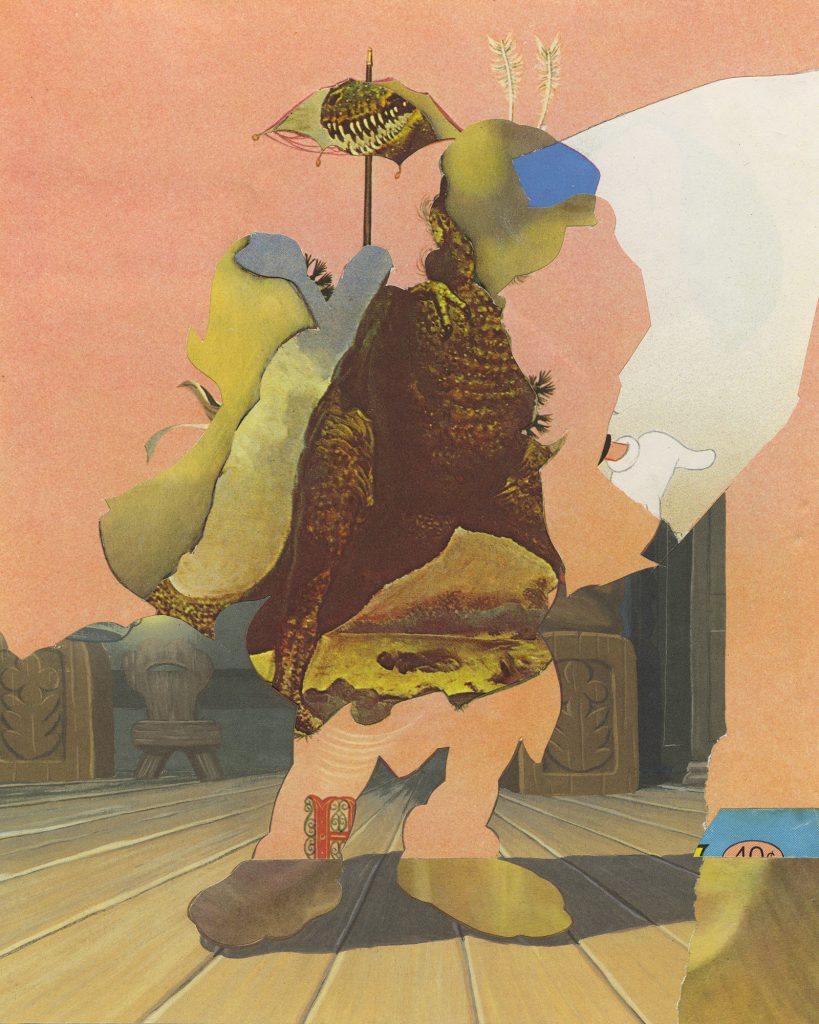
Archival pigment print (from analog paper collage on book cover)
Buy this limited edition print on TWS Gallery
TWS – Can you describe the pieces you’re showing in this exhibition? Walk me through what we’ll encounter.
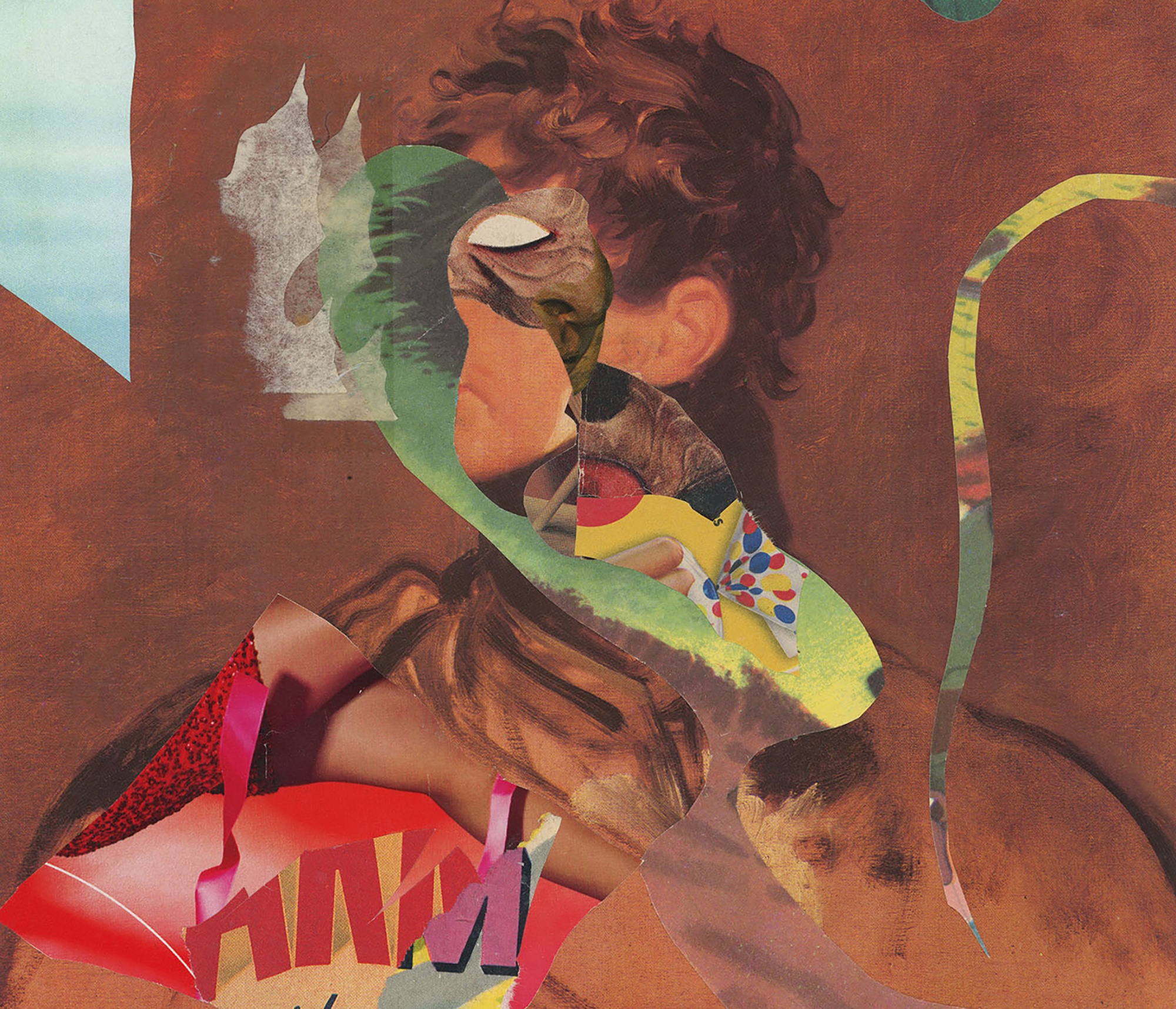
PH – The three works available as prints are quite different in approach and effect from the two originals. The originals are part of an ongoing series, Heroes & Leaders, that use portraits on full pages pulled from art history books as the ground material. It’s a simple, additive process of trying to combine as few elements as possible while altering meaning and obscuring enough of the original that it becomes something new. Some of those elements, as mentioned above, are notes of colour or texture that alter the tone or mood of the image while other elements (eye, microphone, tree, chain etc.) are recognizable signs that our eyes/minds can latch on to and develop meaning. As this series developed, I was thinking about the kinds of people who could have their portraits painted, where that wealth came from, but also the role of the artist in society.
The other three use the basic starting point of cutting out the primary object/figure on a page and using the remaining ground as a framing portal or window. I often cut a figure out just to see what interesting shapes are left behind and echoes. The cutout figures or objects then enter the disarray of my work space and often reemerge later. These three works, though different in tone, each capture an energy and movement of the body. I think they also convey a feeling without having a clear, direct message. I like that they can operate somewhat ambiguously, be repulsive, beautiful, subtle, critical, and/or a bit funny.
TWS – You’ve talked about creating works “held together by tensions”—between pattern and pictorial illusion, abstraction and figuration. Can you expand on that? How do you cultivate that tension without letting the piece fall apart?
PH – I’ve touched on this somewhat in a couple of questions above. Tension is created by movement (or the potential/perceptions thereof) or juxtaposition. In these illustrated elements we have bodily mechanics, gaze, gesture, graphic explosion and splash etc., each of which creates the perception of dynamism in a picture. Similarly, the formal components of line, shape, colour, texture, operate optically to move the eye around a picture and offer space to rest. With collage, we have all these individual pieces. Sometimes the combinations create a recognizable illusion (putting a new head on a body) or they simply continue a line or shape from one element to another. At other times we make obvious choices to break that illusion and create a clear division in material. A successful collage happens for me when I find a satisfying balance between those illusions, movements, and graphic/abstract elements, when there is an optical (conscious or not) push and pull between the whole and the parts.
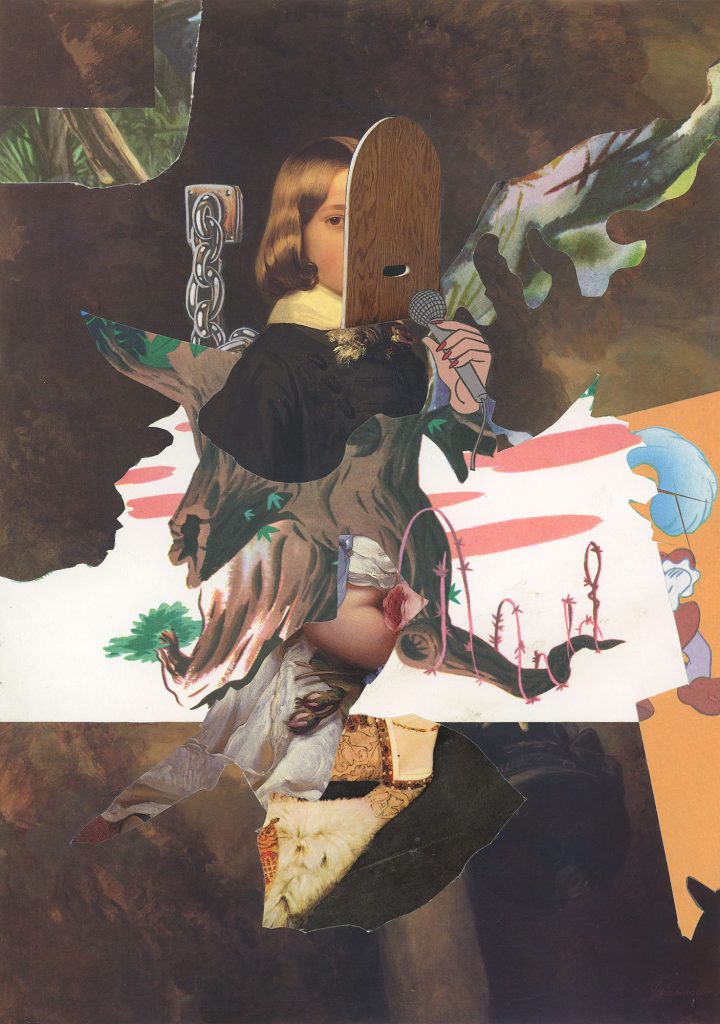
Analog paper collage
Buy this original artwork on TWS Gallery
TWS – You mention being “guided by intuition and curiosity,” letting ideas emerge through making. Can you walk me through your process? How much do you plan versus discover as you go?
PH – There are always exceptions, but I tend to plan very little. I find a lot of magic in the random and in scraps and try to let a work tell me what it’s about during the making. There is often a point where that shifts and becomes clear, and I end up on a hunt for a specific element that can complete the picture. I often begin with piles and groupings of material that have accumulated and been set aside during the making of something else. When I eventually clean my desk, there is often a delicate archaeology that happens as I uncover forgotten works in progress. Another aspect of my practice is the publishing of zines, which allow me to look back through my archive for threads, or make new series’ with intention.
TWS – Your collages often feature figures that emerge and then dissolve back into pattern or void—bodies and fragments that shift between recognition and abstraction. Is this disappearing act something you consciously orchestrate? What interests you about that threshold?
PH – I think a lot of collage artists begin with some form of erasure. If you want to make another entity’s material your own you inevitably obscure or alter it in some way. Abstraction was a beginning for me, but as my practice evolved I found more potential for meaning in representation, so I’ve come to a place where figures and objects are more prominent and identifiable. So yes, it’s consciously orchestrated similar to the other elements and tensions mentioned above, sometimes that’s just a direct result of collage (parts are combined) other times the choices serve the picture through form or meaning. As humans I think we’re always compelled by representations of ourselves.
TWS – You talk about loving “the physicality and immediacy of collage” and “the infinite possibilities” it allows. What is it about the physical act of cutting and gluing that appeals to you? What does collage let you do that other mediums don’t?
PH – So much of our lives are passive, mediated, on-screen experiences, so collage and most art/craft is oppositional to that. It’s active and creative, tactile, physical. You’re in and aware of your body and your mind. I like that I can be but don’t have to be precise. I like that it’s mainly a ‘dry’ medium. I like that material is abundant and free. I like that I don’t have to conjure an idea out of thin air, I can just put two found bits/images together and something new begins.
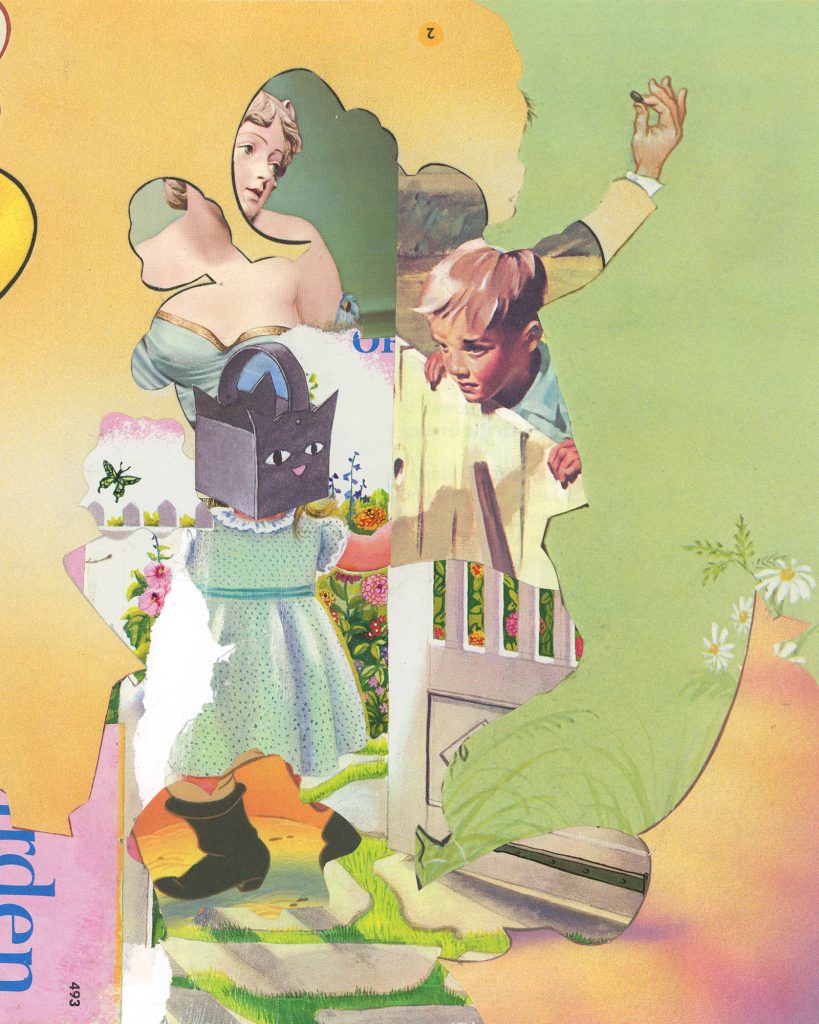
Archival pigment print (from analog paper collage)
Buy this limited edition print on TWS Gallery
TWS – You mention collage has given you access to “the slow meandering of the interior conscious and unconscious mind.” Can you talk about that? What emerges from that slower, more meandering process?
PH – In a lot of ways, the ‘what’ doesn’t matter. It’s allowing time instead of filling it. There is something unique about the creative process, where you can be so full of concentration, focus, and be fully present, but your mind can still wander off. I think that’s very different, and more helpful, than scrolling the web or Netflix.
TWS – Have you looked at the other artists in the exhibition? There’s this thread running through the show—artists working with rupture, transformation, the space between things. Does that resonate with your practice?
PH – Of course! I’ve been aware of all the artists’ work for some time now, a lot through your work at the Weird Show, and we were lucky enough to travel to Spain last year for the Los Raros/Las Raras exhibition where we met Susana and Niko, and saw some of the other artists’ work in person. I would say rupture and transformation are inherent in most, if not all, collage. But yes, I think much of what I’ve said above could also be articulated with these words, in a formal sense and/or meaning-making. Through ambiguity, I try to create a space for poetry between the work and the viewer, where they can create meaning and find a way into the work.
TWS – The exhibition is called Phantom Tigers & Parallel Papers. Your work deals with images that “contain their own undoing,” with what seems coherent but is “stitched from conflict.” How do you relate to ideas of the phantom—of things that appear solid but are actually unstable?
PH – I relate on many levels, most of which I’ve mentioned above, and I must say I appreciate having smart, articulate people write about the work and obviously appreciate and understand in some way what I’m getting at! I do think the words you’ve chosen speak to my process and intent, to the way I make and what I might hope to achieve by creating pictures. I would hope my work can articulate in some small way both the beauty of life and the inevitability of death, and the precarity/absurdity in all of it/us.
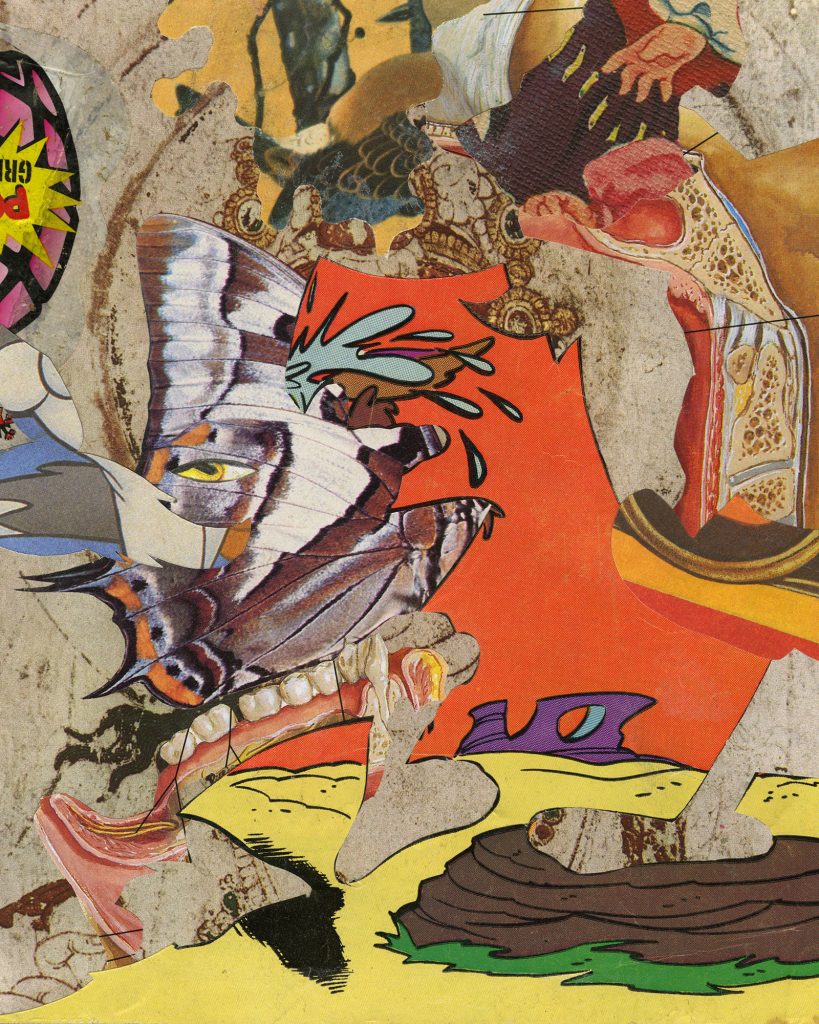
Archival pigment print (from paper collage original)
Buy this limited edition print on TWS Gallery
Find more about Paul Henderson on his website or Instagram.
You can also acquire his original pieces or prints in the current exhibition of TWS Gallery
For more features of Paul Henderson on TWS:
Paul Henderson’s fragmented narrative of the absent.
The Sources: Paul Henderson. Extraction is the new appropriation.
Weird Bookshelf: Paul Henderson – The Soft Apocalypse