Lesley Finn shimmers between analog collage and writing, diving deep into archival research, and crafting books like they’re spells. Armed with a degree in medieval literature and training in book arts, she hunts for found images like treasure and collages in the tension between words and visual imagery. She works with poetry erasure and various plastic techniques, ranging from inking to exploring the glitchy, copied-to-death quality of images. With preparatory exercises designed to shut down the bossy, linear, rational brain, she allows her body to enter into the trance of dream-like creation.
TWS- How do you choose the images and materials that you will work with?
LF- So much of what I work with comes from visiting used bookstores, library sales, thrift and consignment shops with no aim in mind. I am guided by instinct, curiosity, and touch. Something about the title or the cover or the materials will grab my attention—a subject I know nothing about, an unusual graphic, a peeling corner. My goal in these initial stages is to remain open to whatever shows up. I will pick up a book and know instantly if I want to work with it or not – I don’t hem and haw at this stage. I don’t favor a particular era or type of printed matter. This instinct-led openness allows for an organic pattern of themes to grow in the sources. It’s like I have a question I didn’t know I wanted to ask, and the images help me to form that question.
Paper is my constant material. I never get tired of it. It always has a lesson to teach me, usually involving patience, observation, and error. It feels alive to me. I am drawn to texture over anything else, specifically textures that are grainy, scratched, and hazy. If I have an image I want to work with that is printed glossy, I first transform the surface. My go-to secondary materials are ones that help me transform texture, rather than color or anything else.
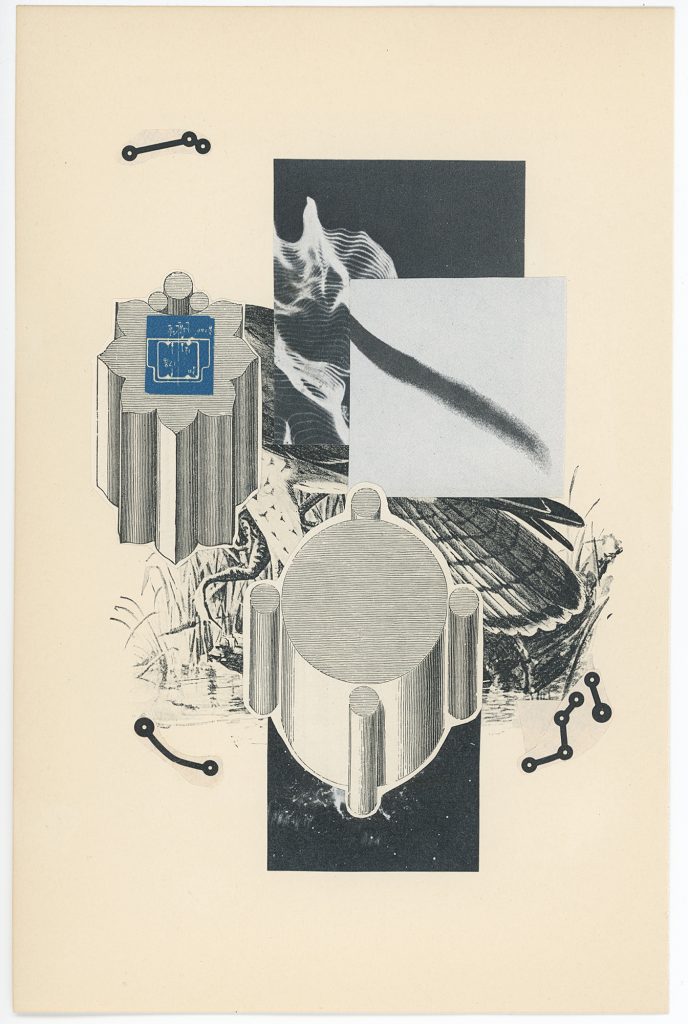
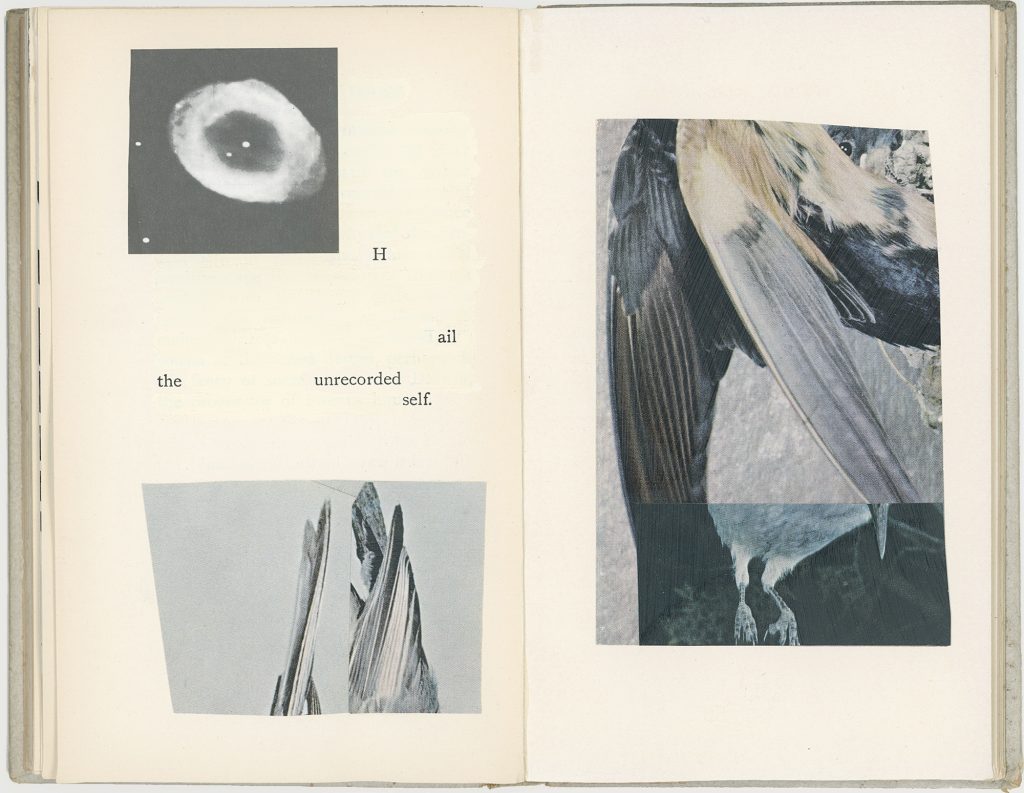
Collage on a book
TWS- You said in your social media that you’ve been thinking a lot about how collecting can be a form of fragmentation, but also restoration, and either way is collage. As a person prone to History matters, how do you relate to both fragmentation and restoration?
LF- I have an aversion to tidy, packaged narratives and rigid categories. Life is rife with them; history is rife with them. I have an urge to unpack and dismantle. When you collect, you remove an object from its original or previous context – that is, at once an act of fragmentation. Putting it into a new arrangement is collage. I’m interested in how both can be acts of care. Fragmentation and collage resist the single story of an object; they restore the possibility of new meaning, of the multiple within the singular. I suppose that’s how I relate to restoration through my work. It’s activation, an insistence on aliveness, resisting the reductive.
TWS- Tell me about collage erasure in your work.
LF- There’s a contradiction in erasure that I am drawn to working with alongside collage. Erasure is, of course, part of collage – in the putting together of images and objects, there is an implicit process of removal. This might be through the act of cutting, tearing, or covering up. In all cases, you see anew through erasure. That’s the contradiction—that in removal, you see more clearly. With my background in writing, research, and book arts, I can’t help but apply this approach to working with words and texts as part of the visual practice. A lot of my work starts with language and the erasure of it. I’ll take a page of printed writing and re-see it through erasure, either painting over words, peeling them off with tape, or focusing only on punctuation. Erasure lets my subconscious meet the paper’s subconscious. It helps me set aside my analytical-linear mind, which isn’t very useful for making art.
TWS – There is a mystical approach one can recognize in the titles and topics of your artworks, like Quantum Divinations, Cosmic Outlier, ghosts, ancient sculptures, the Goddess of the Deep Self… why do you feel so kin to explore these topics with collage? I am really curious about your path from a medievalist to a collagist.
LF – There was nothing mystical in my environment growing up, and maybe because of that, I was drawn to it. I always loved books as objects and the way they made me feel; reading was time-travelling, place-travelling, mind-expanding. Ghost stories and folk tales were favorites. I liked the idea that the world was not what it seemed, that there were other realities. I went to college knowing there was something in books and writing I needed to pursue. Medieval literature was the most book-forward subject I encountered.
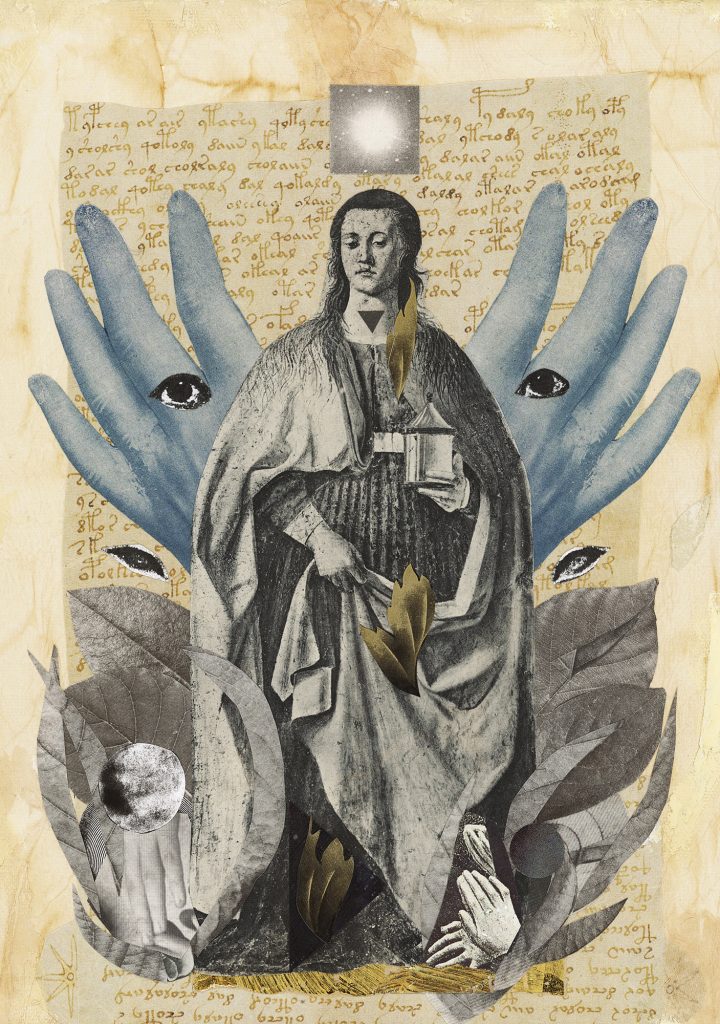
Paper acrylic and gold foil on canvas
The medieval book is an object of high stakes – reading in that era could result in death, transcendence, or sainthood. There was a lot of fascinating work being done in medieval studies when I started getting interested in the field – queer theory, postcolonial theory. I wasn’t in it for the courtly love. I was drawn to the odd texts, the spiritual tracts that read like fever dreams, the mysterious ephemera. My research and writing were always trying to make sense of the fragments and contradictions, trying to draw unlikely parallels, contesting simple interpretations – it was a training in a collage mindset, and in nuance and the mystical.
I tried to be practical and went into trade publishing after graduation (where, funnily enough, I worked on things like oracle decks), but I missed the intellectual rigor of academia, working with archives and libraries, so I returned to grad school, thinking I’d become a professor. But as much as I loved the research and learning how to read fifteenth-century handwriting, it was like I couldn’t get close enough to the materiality in that work. And it was too easy to get stuck in my head. I dropped out of my PhD program, knowing I had to find a way to do what I was doing in a more tactile form. A friend of mine remarked when I left the program, Once a grad student, always a medievalist. She was so right.
I joke that I have had every job and training dealing with words and books in all their shapes… let’s just say that many years followed of picking up skills that eventually led to me focusing on collage as the gathering method, the ideal container and process for asking the questions I want to ask.
For me, collage is mystical. The materials I work with have their own histories, their own spirits. Collage allows me to drop away from the conscious mind and make seemingly impossible associations. It helps me reframe and rearrange what I think I know. The shading in an image of an arm lines up with the grain of an image of tree bark and I begin to question definitions of “armness” and “treeness.” The unfoldings, the openings, the connections that collage generates – that feels so profound to me, beyond logical explanation.
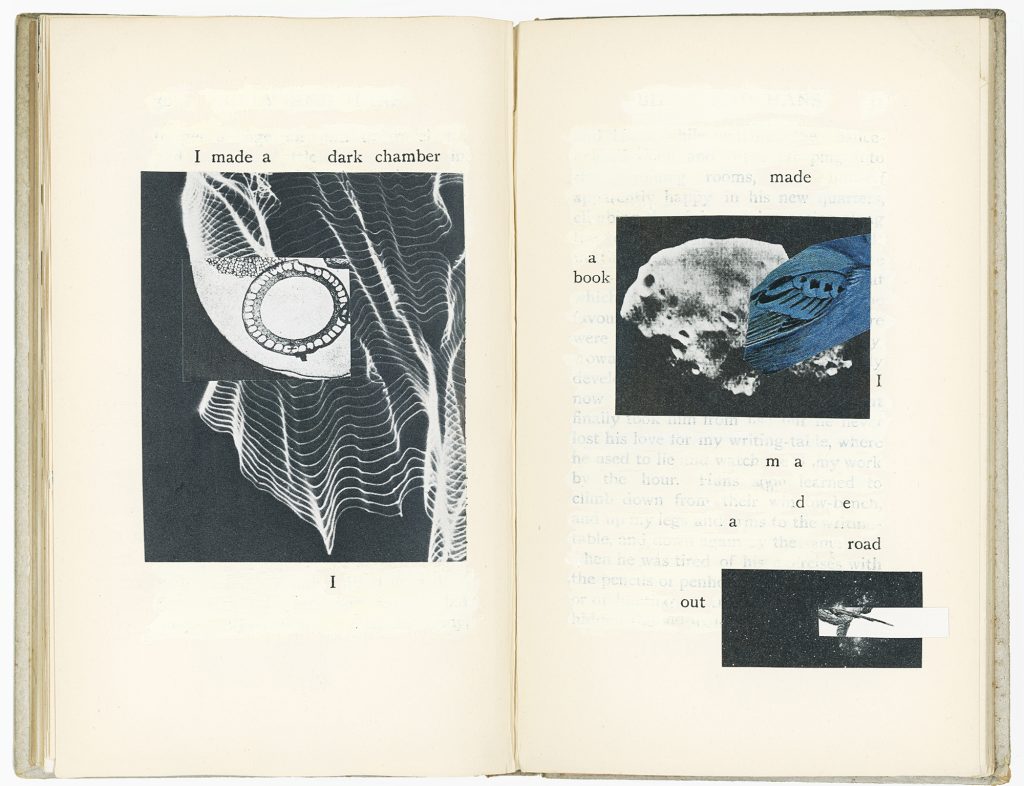
Paper collage on book pages
TWS – Exploration of diversity is part of the metaphysical and the physical dimensions of your artwork. You are thrown to different approaches for working with paper, using inks, pigments, transfers, photographic techniques, tapes, and folding… There is something intricate in your analogue practice. Invite us to it…
LF – I choose techniques the same way I choose source materials: I remain open and in an improv state of mind for a long time before I settle down. I might make a dozen different approaches to a substrate, trying until one of them clicks. It’s a felt alignment, as if the materials nod in approval to the approach. At that point, I set some project constraints through palette and source material so that I can move ahead with the work. It sounds like a lot of trial and error, and I guess it is, but that preparatory effort always shows up somewhere else, in another work down the line. I’m not interested in mastering a technique, but in being open to what I can learn from my process and carry that forward. I guess I am, in terms of the approaches I use, in a perpetual learner’s mindset. It’s funny how that shows up visually as “intricate” – almost as if all the energy I put into that process comes through on the page, even if the composition is minimalist and spare.
TWS – You like to work with photocopies. Why? How is your selection process? How do you experiment with the materiality of something already derivative?
LF – I was a ‘90s teenager – the photocopier was magical then, and it still is. To be able to make zines affordably, to be able to take home a copy of your favorite book pages, and write on them. It was an institutional, corporate machine that the public had access to – it’s remarkable in that way. And then there’s the gritty monotone texture, the unexpected errors – there’s something ghostly about photocopied material that appeals to me, as though you are seeing something from another dimension. I’m inspired by Bruno Munari’s “Xerographies” which experiment with photocopying fur, rope, and other materials, by Barbara T. Smith’s books made from scanning her chest, her face, and her hands. I love that they are taking a machine intended for dependable replication and instead creating one-of-a-kind work.
I work with photocopies via scanning too – if I am using a source text that is rare or part of an archive or that contains an image I want more versions of, I will scan or photograph it, and use that opportunity to alter it in some way digitally – zoom in on a detail, create fragmentation, change transparency. With that derived image, I transform it again by printing it on special paper. Thin Japanese mulberry paper is a favorite, as is transfer film that I might additionally paint or coat to create texture. The copied-ness of the image feels like a representation of the image that I carry in my mind. Through copying and distorting, I can get a bit closer to sharing what I’ve internalized rather than what everyone sees.
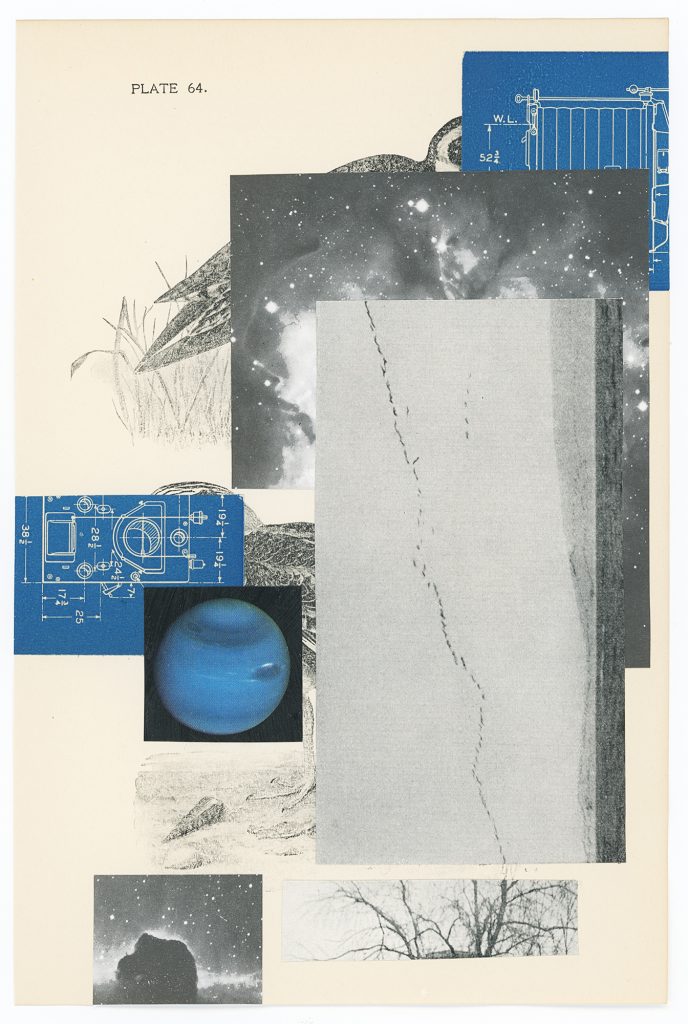
Paper collage on a book
TWS – I find it fascinating your facet as a writer, and your own reflections on your collage-making process. Books are really your thing, yet you create them with one hand and erase them with the other…
LF – It really helps me to write about my process. I started a newsletter called Collage Mind a few years ago to create a container for that, for writing about process specifically as someone working with writing and visual art via collage, and it has been integral to gathering and digesting and sharing and connecting and capturing in ways I could never have imagined. Writing about my process is part of the process! It’s my hope that in being open about that and sharing it, I might pass along some positive energy and ideas.
Creating with one hand and erasing with the other – ha, yes. I am an expressive person, and expression for me is multifaceted, multimodal. Gemini to the core!
TWS- As a writer, how do you approach collage from a storytelling point of view?
LF- Collages have characters (which may be humans or animals or colors or objects), and because of their relationships with space and each other, they create tension and mood. Whether you include the whole or a part of an image, an overlap, or the promise of connection, alignment, or contrast, that communicates different kinds of presence. The storytelling I work with, I suppose, is glimpses of scenes – or maybe even slow-motion capture of scenes.
When I make collages, I am pulling guidance from the screenwriting classes that I took during my MFA in creative writing. The program I attended required us to study multiple genres, so even though I ended up concentrating in fiction, I got cross-training in narrative form. Screenwriting was profoundly influential for me. On the one hand, I love film, and learning how to write for the medium gave me a whole new way of viewing it and appreciating it. On the other hand, the craft really appeals to my brain. In writing my own short and feature-length films, I had to construct scenes in a way that felt a bit like emotional algebra, and work with image and language at the same time. One of the bits of screenwriting advice that has stuck with me is to write scenes in which the viewer arrives late and gets out early. It’s another way of making sure nothing is static or unnecessary, that there is in motion, either emotional or physical, or both. I like the idea of creating collages where the viewer feels like they saw just enough to grasp a feeling or sense of a place, but want to know more.
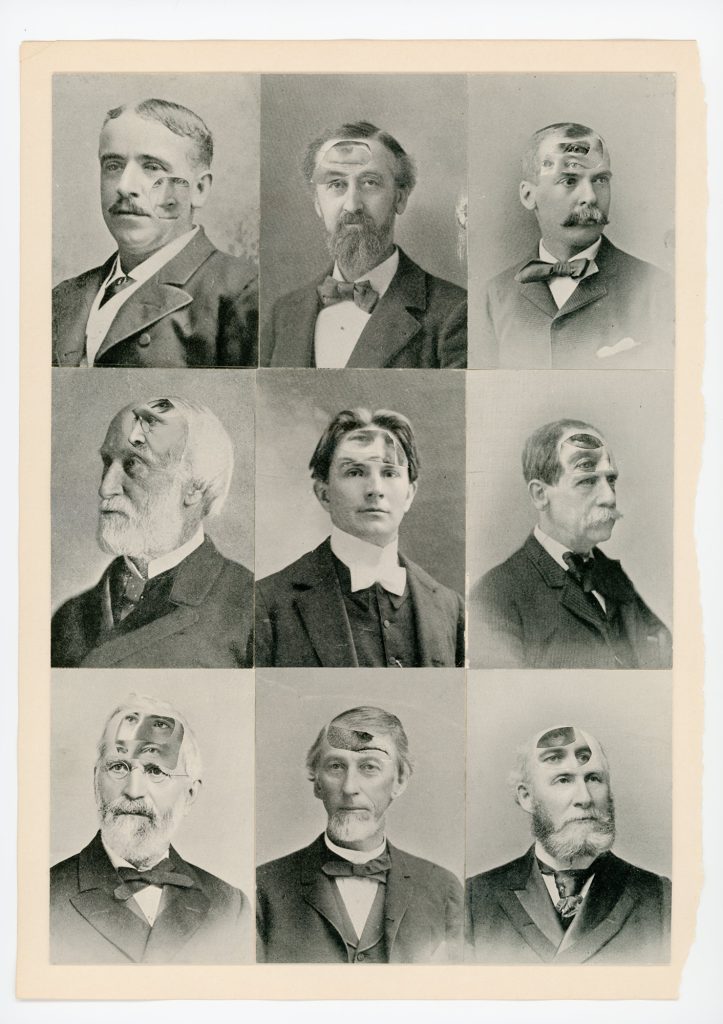
Collage of book pages on card stock
TWS- And on the other hand, does your collage practice influence your writing practice when you are making stories other than collage reflections?
LF- For me, collage has always been a part of writing – it’s just a question of how much shows up on the page. In high school, I learned how to write research papers using the index card method – record one idea or quote per card, then lay out all the cards and put them in an order that makes an argument (which is a version of telling a story). That’s collage. I still use this method to write essays and other creative work, even though sometimes I rely on software to do that – the program Scrivener allows me to write in segments and move them around easily. To write from beginning to end can suck the magic out of the process; to write out of order unlocks so many unexpected connections.
My favorite pieces of writing I’ve produced relied heavily on collage. One was a short piece that I created after spending a few months compiling a single observation per day on an index card. I brought them all together and started to notice themes and links, ditched the ones that didn’t add anything, then played around with order. That is exactly how I compose a collage. Another piece came together in a similar way but involved me watching horror films and taking notes on that and reflecting on my past – I eventually created a master Word document that I then printed out and cut up into pieces. I drafted the essay by taping the fragments together in a new order. And now I am working on a book that uses another method from my collage practice: putting two seemingly unrelated sources into conversation to see what gets kicked up, and writing about those overlaps and entanglements.
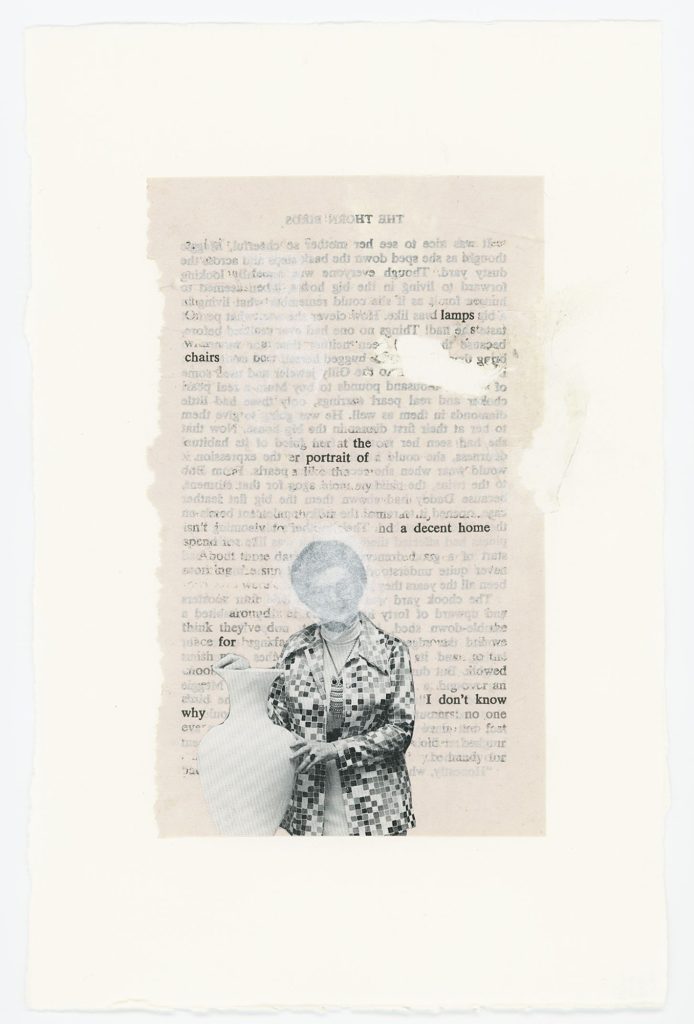
Paper tissue and book page collage on Arches text paper
TWS- What is your collage process? How do you start a piece? How do you select its components? How do you know when it is finished?
LF- Creating systems that remove all friction from making work is key for me. So, I either begin with a substrate that is printed matter, or, if it’s a blank substrate, I use surrealist techniques to mark the page. Scrunching up the paper, randomly dropping pigment onto it. Sometimes that start has a particular meaning to a project, like a series I made in 2025 that I began by throwing my grandmother’s rosary onto a wood panel and tracing those lines. Having the first mark being made by chance or pre-existing material is so freeing. Everything that happens after is a practice of paying attention but not overthinking.
My studio space is set up to ease friction, too. I learned a lot about how to organize a bench from training in book arts, especially learning gold tooling from the artist Tracey Rowledge. People who visit my studio remark on its order and calm – this puts me in the best position for starting a piece. It’s chaos soon after, but because I have a system, I am never hunting things down. I worked in food service as a teenager and in my 20s, and it’s a bit like arranging a short-order station or mise en place. You can’t waste time wondering where the butter is.
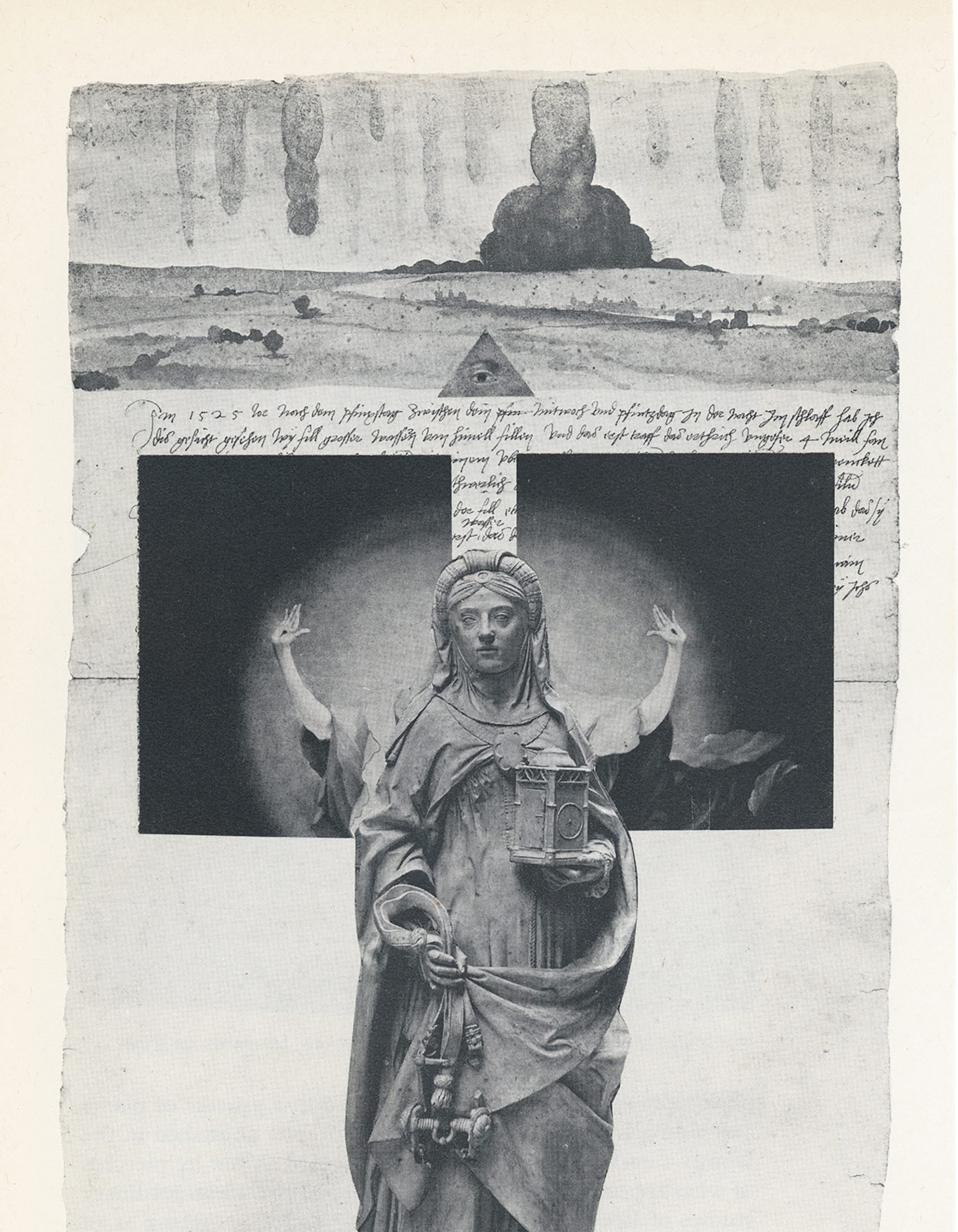
I select components for what they suggest in terms of meaning but also based on visual elements. Recently, I seem drawn to hands, birds, blurs, electrical circuitry, the color blue, handwriting, sculpture, flowers, trees, and astronomical elements, and organize materials accordingly. But this is always changing.
There is so much trial and error. So much testing. Turning the composition upside down, photographing it in black and white. Stepping back. Going out for a walk.
In terms of knowing when a piece is finished, it’s a feeling of stillness and resolution, like the piece has resolved itself and created a new energy all on its own. I might try to add or subtract an element, and if it gets neither better nor worse, I’ll let the piece sit and come back to it and check in again. That could happen in a few hours, a day, or a week. For bigger pieces, months.
TWS- Do you have any rituals during your collage making?
LF- When I have a good chunk of time to work, yes. I might reach into my rituals toolbox for something to help draw a boundary between whatever I was doing before and what I am about to do – this really helps to ground me in my body and quiet my linear-logic brain. I often have a large piece of paper on a wall that I then use for warming up – I either make a circle over and over or write words in cursive over and over. Big, looping movement. It’s something I learned in a drawing class years ago and really love. The warm-up gets my arm loose and lets me play around with all sorts of media. All sorts of discoveries happen. I’ll use that paper eventually in collages. Nothing goes to waste.
But many collages happen without these rituals, on the go, a quick let’s-see-how-this-works sketch. I suspect one version of making feeds the other, and vice versa.
TWS- What is your personal understanding of collage? And why do you think it is important in the contemporary visual world?
LF- I think collage is intrinsic to consciousness. It had a moment in the early 20th century as a formalized artistic method, but people have been collaging long before that, and outside of Western Europe, and outside of official art spaces. It is mark making, sensemaking, on a deep, mysterious level. And that’s why it is important in the contemporary visual world: it helps us reflect on how we process and create knowledge, on what is connected and entangled. Collage is relational. It resists linear time. It refuses binaries. It complicates the simple, single stories and celebrates the multiple. It helps us see possibilities where there was seemingly none. We need that right now. Badly.
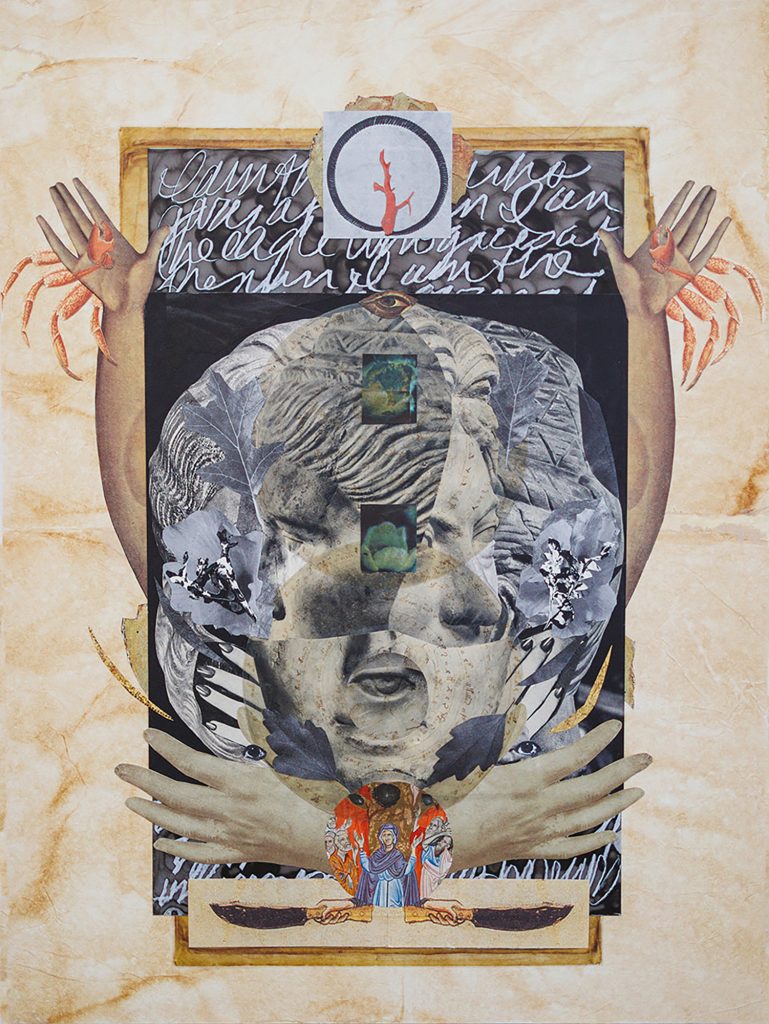
Mixed media collage on wood panel
TWS- What is the most precious thing that collage has given you?
LF- Community and integration. It has brought me into relationships with so many brilliant people, with so many ideas, with so much learning, with so much growth. Through connecting with others working in collage and connecting with that community, I’ve been able to connect within myself in important ways. I’ve been able to integrate parts and interests that I had been keeping separate, and this has helped me show up in my art making, not in the spirit of either/or but both/and.
TWS- If you were a collage piece, how would you be, and which title would you have?
LF- I’m going to bail on the title – that always comes last for me, and from language in the material I work with. Maybe I am a small, deceptively detailed piece. Muted colors that don’t grab attention but haunt. Maybe you look at me and think, What is that? I contain something from your dreaming. There are words in me that show up in a book you read 10 years from now. Hopefully, I slow down time just enough for you to feel a bit of peace, and then an unexplainable desire to go to a library and wander.
Learn more about Lesley Finn on her website or Instagram
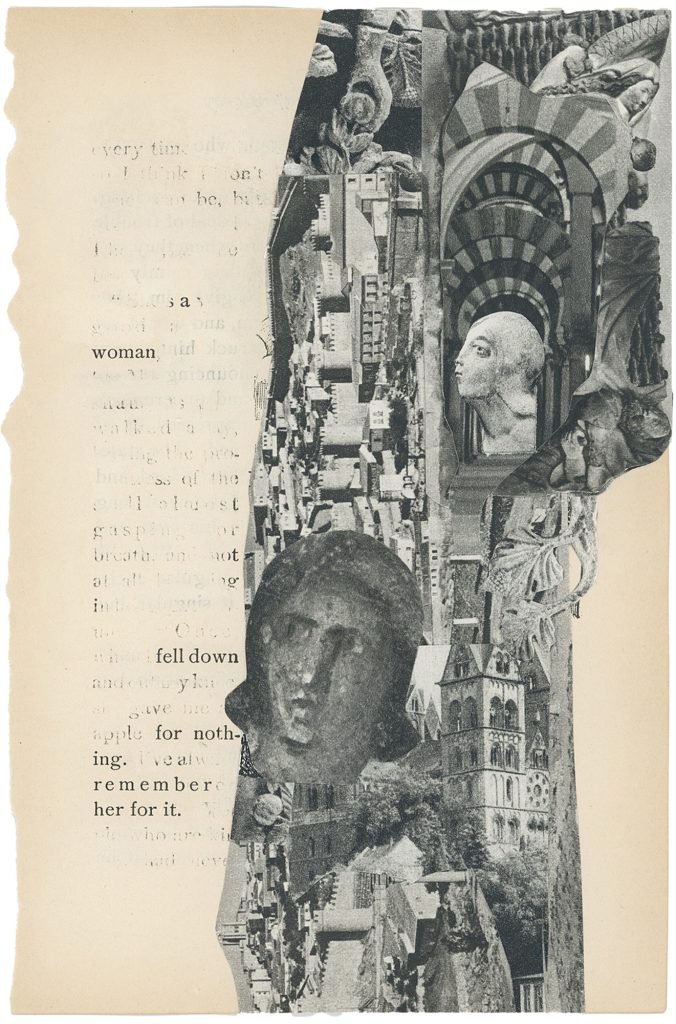
Paper collage on a book page